
Hi there, my friend!
As I always try to be clear about, this newsletter is about you.
It is about helping you understand that you have more power over your money than you realize. I’m committed to showing you how to pay less, earn more and keep more of your hard-earned money by asking the right questions in various everyday situations. Every edition of this newsletter, every Thursday, will include some takeaway that you can use to better your financial life — and this one is no different.
However, sometimes in providing that information, I like to take you behind the scenes of my job.
I did that with my most recent media tour…

I did that when an announcement from the president threw a wrench into my Friday night…

I even did it a little less than a year ago when Jimmy Kimmel quoted (albeit inaccurately) a report I did in his late-night monologue…

That last one was particularly unique. I’ve been quoted and cited — or had something I wrote quoted or cited — by most any news and personal finance media outlet that you can name over the years. However, having a late-night talk-show host talk about something you write was something new for me.
To make something like that happen, you have to create content that gets people talking. Another report I wrote last week has certainly done that, too.
The number that got people talking
I recently wrote an article for LendingTree that stated that it would cost an average of more than $300,000 to raise a child over 18 years. That’s more than $17,000 per year.
Yeah, you read that right.
It’s an eye-opening report, with data put together by LendingTree’s brilliant research team, and it is absolutely worth a read. It also breaks down the costs for just the first five years, when daycare costs are brutal, as well as how costs vary by state. (For example, it can cost $400,000 to raise a kid for 18 years in Hawaii, but just slightly more than $200,000 in New Hampshire and a few Southern states. A massive difference, though also proof that parenting isn’t cheap anywhere in this country.)
The report has generated a massive amount of talk, including coverage from CBS News, Fortune, NewsNation, local TV and radio stations all over the country, and even Fox News’ morning show “Fox and Friends.”
They didn’t interview me or anyone else from LT for the segment, but that Fox & Friends conversation spurred even more coverage, including Huff Post and even TV Insider, which is not an outlet that typically picks up what I’m writing. Even IMDB (the Internet Movie Database) posted about it, linking back to TV Insider. Again, not my usual territory, but it is great to see people talking about what we wrote.
The biggest main reason why it is so great that this is being talked about is that this is a MASSIVE problem in our country.
Conversation raises awareness. Awareness, ideally, breeds action.
The takeaways from this report
As usual, I’m going to tell you that you have more power than you think you do. That doesn’t mean that everything’s going to be perfect or that managing these costs will be easy, but there are steps that you can take to help yourself.
Here’s my first recommendation from the LendingTree report…
“Start saving as soon as possible. Like today. If you’re thinking that you want to have a child in the next few years, it isn’t too early to start a fund devoted to the cost of raising a child. Put a few dollars from each paycheck into a high-yield savings account and let compounding interest work its magic. By the time your little one arrives, you’ll be glad you did.”
I know this is easier said than done, but it is absolutely essential. I always think about the old saying about the best time to plant a tree: “The best time was 20 years ago, but the next best time is today.” That is certainly the case with savings and investments, because no financial asset we have is more powerful than time. As silly as it may sound, if you know for certain that you want to have a family someday — even if it might not be for 5 or 10 years or more — start putting a little bit of money away for it. Call it your “Family Fund” and know that when your little one arrives, you’ll be thrilled that money is there.
And don’t worry that you’re not doing enough. Just get started. Start small, be consistent, and just let that money grow.
Here’s another recommendation from the report…
Take advantage of government and/or workplace benefits. Once you know your child is on the way, reach out to your company’s HR department to go over what benefits are offered for parents. If you don’t take the time to do that, you could leave money on the table, and that’s the last thing any parent should do. Also, use a dependent care flexible spending account (FSA) to pay for at least a portion of your child care costs with pretax dollars. Finally, make sure that when tax season arrives, you’re claiming all the credits you qualify for.
This stuff matters a lot. With costs as high as they are, parents need all the help they can get, so make sure to seek out as much of it as you can.
There are more recommendations in the report, as well as much more information on just what that $300,000 number includes. I highly recommend giving it a look.
Look what I found
So after finding the IMDb reference to our report, I had an idea.
I’m going to look up my name at IMDb.com.
There’s really no reason for me to be in there. I’ve never been involved in making a movie. I’ve never really been involved in making a TV show, outside of countless appearances on news shows.
Even knowing that, I looked myself up and, as it turns out, I do have an IMDb page…
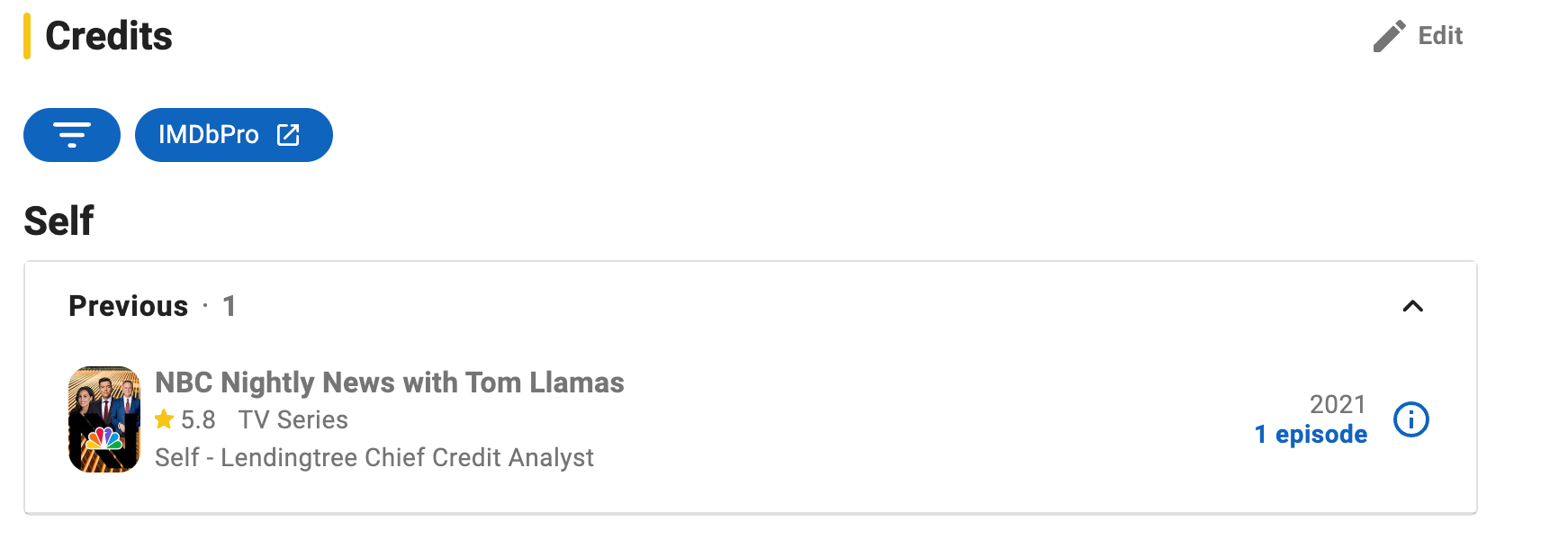
At some point, someone created that page for me, with the only credit being an appearance I made on NBC Nightly News back in 2021. I have no idea who made it or why, but I think it is fun to know that I have one.
And it turns out I have Huff Post and Fox & Friends to thank for that knowledge. Who would’ve guessed?
Until next time!
Matt