Hi there, my friend.
“The biggest fear when it comes to communication is just the fear of how we will be perceived.”
Lauren Petrowski, a former TV anchor turned media and public-speaking coach based here in Austin, told me this in a recent email interview, and I agree with her. Often it isn’t fear of failure that keeps us from making that call or having that conversation. Instead, it is fear of judgment.
What is this person going to think of me? Am I going to look like a bossy jerk? Will I come off as being “too much”? Are they going to think I’m stupid?
That fear can keep us frozen in place, even when we know we will likely get our way if we merely ask. We’d rather be stuck and settle than risk the judgment of others.
I first met Lauren years ago when she interviewed me on the Fox 7 Austin morning show, which I appeared on several times over the years. More recently, I’ve followed her rise as a public-speaking and confidence coach via social media, so I asked her if she’d be willing to share her wisdom with Ask, Save, Earn readers. She was nice enough to say yes.
Scroll down to read the lightly edited transcript of our email interview, including her take on how to overcome that fear of judgment that keeps so many people trapped.

Matt Schulz: First, tell us a little about yourself and what you do.
Lauren Petrowski: I’ve spent my career talking to people -- both on camera as a TV news reporter, anchor and host, and to rooms full of people as an event emcee. I also work with entrepreneurs and professionals as a media and public speaking coach to help them communicate with more clarity and confidence. I recently started an Instagram interview series called “Let’s Get Curious” where I have quick chats with creators and founders who have built an audience in Austin. And I’m a mom of two young kids.
MS: My newsletter is about helping people pay less, earn more and keep more of their hard-earned money by asking the right questions in various everyday situations. A lot of our readers know exactly what they want to ask for (a refund, a raise, a lower bill) but freeze up before they say it. What's actually happening in that moment, and what's the fastest way out of it?
LP: I think this is something many people struggle with, myself included as a perpetual people pleaser who will avoid confrontation at all costs.
The reason we get nervous or freeze up when asking for something we want is because of fear of rejection. Our brain automatically goes to the negative possible outcome. We weigh that possible rejection or loss more heavily than the possibility of getting what we asked for.
I also think conversations involving money make us more vulnerable. A simple ask of “Can I get this bill lowered?” can produce a more nerve-wracking response than it probably should because it involves money, and that is personal.
In that moment, we don’t need to just be more confident but also firm and concise. Our instinct is to add justification, and we get tripped up in the “I’m sorry to ask, but...” or “If it’s not too much trouble...” If you know there is something you want to ask for, state the ask and then stop talking.
MS: Why is it important to stop talking? How difficult is that pause for people, and do you have any practical advice for standing the silence?
LP: You always want to give the person a chance to pause and reflect on what you’ve asked. You also want to make sure it lands and you’re not wavering. Silence can make us uncomfortable and make us want to fill the space, but pausing conveys confidence. You’ve made your case and stated your ask, and now you’re giving them a chance to respond.
Silence can make us uncomfortable and make us want to fill the space, but pausing conveys confidence.
MS: You coach people to sound confident on camera under real pressure. Do any of those techniques work well on the phone with a customer service rep or in a salary conversation?
LP: Yes, there are definitely some techniques that would transfer over. Appearing confident on camera or when we speak is not just about having confidence but about our pacing, taking breaths and pauses, and ability to maintain a steady tone. When we’re nervous or worked up about something, we tend to speed up and talk at a higher pitch. In these situations, it is important to slow down your rate of speech. That will make you sound more confident.
Also, learn when to pause instead of rambling or adding filler words such as “like,” “um,” “so,” etc. And take breaths if you feel yourself getting nervous or worked up.
MS: Is there one particular hang-up or fear that you see most commonly in people that keeps them from being good communicators? If so, what's your best advice for getting over -- or perhaps through -- it?
LP: I would say the biggest fear when it comes to communication is just the fear of how we will be perceived. Most of us don’t want to be perceived as too much, too pushy, too demanding or too confident. Separate the ask — or what you’re trying to communicate — from how you think you’ll say it. Asking for a raise, a bill to be lowered or a fair rate for a service is not unreasonable. We just need to better trust ourselves to deliver that communication.
MS: Are you naturally comfortable negotiating with people and asking for breaks, and do you do it much outside of your job? For example, have you ever called a business and asked them to lower your cell phone bill, waive a late fee or something along those lines?
LP: Although I consider myself a natural communicator, I am not naturally comfortable negotiating or asking for things. However, I have had success with this when canceling a membership. Many apps or sites that have annual fees will offer a discounted rate when they find out you’re about to cancel. Also, I have asked companies to come up with a better rate for phone and internet service, and I’ve had success with that. Most companies would rather keep you as a customer, even if it means lowering their rate, than lose you.
MS: Anything that I haven’t asked that you’d like to add -- or anything that you’d like to re-emphasize?
LP: I’d reiterate separating the ask from concern over how you’ll be perceived. Most of these potential situations are reasonable and worth asking for. I talk a lot about curiosity and how being curious leads to opportunities. In these moments, curiosity can lead to a yes, which is the goal. The potential for a yes should outweigh our self-consciousness. Easier said than done, but like with anything, it gets easier with practice.
The power of the burger refill
Lauren’s last point is so important: Changing your perspective and overcoming your doubts and fears can be anything but easy, but with practice and repetition, it can become a bit easier.
That brings me to one of my favorite Ted Talks. Here’s the description of it on YouTube:
Jia Jiang adventures boldly into a territory so many of us fear: rejection. By seeking out rejection for 100 days -- from asking a stranger to borrow $100 to requesting a “burger refill” at a restaurant -- Jiang desensitized himself to the pain and shame that rejection often brings and, in the process, discovered that simply asking for what you want can open up possibilities where you expect to find dead ends.
You read that right. It says “burger refill.”
Yeah, it is silly, but the underlying message is the same Lauren shared and that we’ve talked about here at Ask, Save, Earn before: Practice matters.
Practice can also take different forms. Maybe it is you role-playing with a friend or relative. Maybe it is you standing and talking in front of a mirror or your phone in selfie mode. Or maybe it is you asking for a refill on that burger.
Check this video out and let me know what you think.
In other news… My latest whirlwind NYC media tour
Last week, I traveled to New York City to join a panel at a conference hosted by the Society for Advancing Business Editing and Writing (SABEW). It was an incredible event, and I got to catch up with old friends, make new ones, and even meet in person people I’d only ever emailed or spoken to on the phone. Can’t wait to do it again next year.
But that wasn’t all I did on the trip. In one whirlwind day, I did the following:
A live segment on NBC News Now at 8:50 am, which you can see below. It is about a recent LendingTree survey showing that half of Gen Zers have received financial support from family in the past two years. Overall, 44% of all parents with adult children have offered some sort of financial support.
A trip from 30 Rock in midtown Manhattan to CNBC’s studio in New Jersey to record an interview with CNBC that will air sometime in the near future.
A trip back into Manhattan for a super-quick lunch at The Halal Guys food cart at 53rd and 6th Avenue, just a couple of blocks from the 30 Rock studio. I freaking love the lamb-and-chicken-over-rice combo platter.

A second live segment on NBC News Now at 1:50 pm. Again, the topic was The Bank of Mom & Dad.
A breather and a chance to answer some work emails in the not-at-all-green green room in 30 Rock
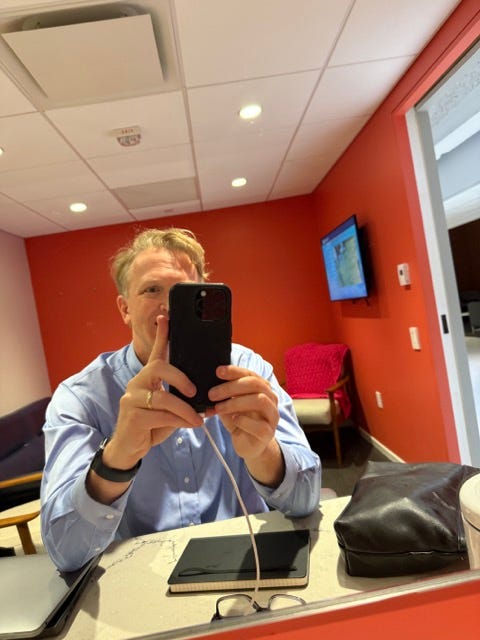
Then, a third live segment at 3:50 pm about parents supporting their adult children financially. So much fun, and such an honor for me to be able to be on so many times in a single day.
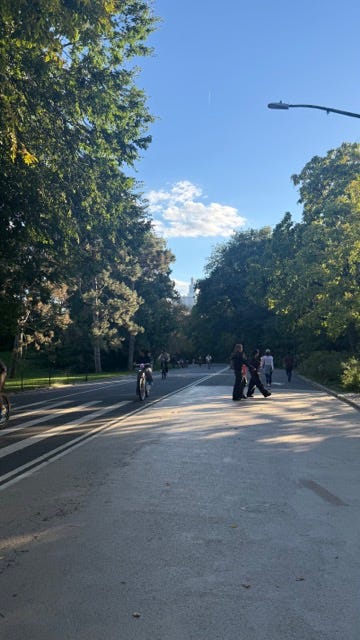
Finally, after a last email check, a quick trip back to my hotel to change clothes and head to Central Park for a run. Yeah, it was a long, tiring day, but not nearly tiring enough to keep me from taking advantage of a spectacular 70-something-degree evening in the park.

Until next time!
Matt